Precious metals crash to hit lower circuit on MCX; silver drops 12%, gold down 9%
Gold, silver rates today live updates: Gold, silver well below record highs
Gold and silver prices extended their sharp decline on Monday after a renewed surge in the US dollar rattled precious metal markets, following reports that US President Donald Trump has selected Kevin Warsh as the next head of the US Federal Reserve.
Gold, silver rates today
Gold fell 4.3 percent to $4,682 an ounce, while silver slid nearly five percent to around $81 an ounce, adding to the steep losses recorded at the end of last week.
The sell-off began on Friday, when bullion prices started retreating after the dollar strengthened on expectations that Warsh’s appointment could signal a more hawkish stance on monetary policy.
As a result of the sustained correction, both metals are now trading well below their recent record peaks. Gold had crossed $5,500 an ounce last week, while silver had surged past $120, before momentum reversed sharply.
US approves potential $9 billion sale of Patriot missiles to Saudi Arabia
Details of the Major Defense Agreement
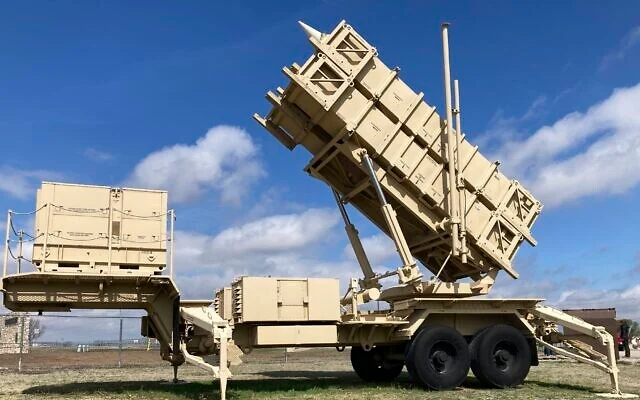
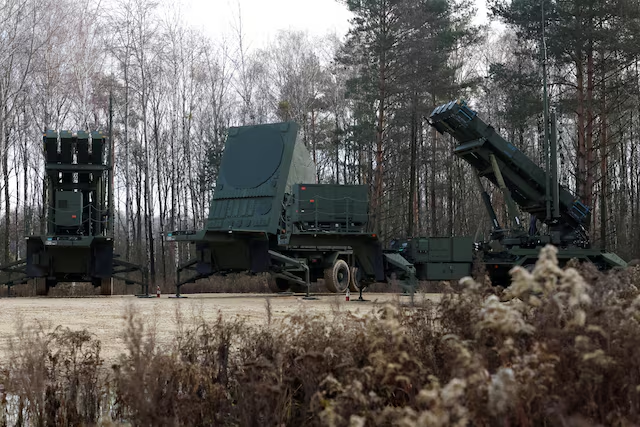
On Friday, the Pentagon announced a significant development in international defense trade. The State Department has confirmed that the US approves potential $9 billion sale of Patriot interceptor missiles and associated equipment to Saudi Arabia. The primary contractor selected to lead this substantial project is Lockheed Martin Corp. They will be responsible for providing the Patriot Advanced Capability-3 Missile Segment Enhancement missiles, commonly known as PAC-3 MSE.
Major Defense Agreement:image from reuters.com
This decision comes directly following a request from the Kingdom of Saudi Arabia to purchase 730 of these specific interceptor missiles. By moving forward with this request, the US approves potential $9 billion sale to bolster the defensive capabilities of a key partner in the region.
Impact on Regional Stability and Readiness
Regarding the broader implications of the deal, the Pentagon provided reassurance about the strategic fallout. They stated that this proposed transaction will not disrupt the fundamental military balance in the Middle East. Additionally, officials emphasized that the transfer will not negatively affect America’s own defense readiness or ability to operate. With these factors considered, the US approves potential $9 billion sale as a measure that supports foreign policy goals without compromising national security.
We have just received our first glimpse of a precious baby gorilla born at a well-loved wildlife park in Kent. Howletts Wild Animal Park, located just outside of Canterbury, is thrilled to be celebrating the arrival of a new infant western lowland gorilla.
Arriving just before the festive season, the little one was born to Sanki and Djanghou, two gorillas with a long history at the park. This new arrival is a massive milestone, marking the 155th gorilla birth across Howletts and its sister park, Port Lympne, combined. It is a true family affair, as both parents were actually born at Howletts themselves; Sanki arrived in 1998, and Djanghou was born back in 1993.
Tracing the family tree:
Sanki is the daughter of Kifu, a silverback who still lives at Howletts, and Sounda, who sadly passed away in 2007. Djanghou, meanwhile, is the son of Djala—a silverback who was released back into the wild in the Congo in 2013 through the park’s rewilding project—and Sangha, a female currently living with the troop at Port Lympne.
This latest little addition is the fourth baby born to Sanki and Djanghou together. All told, Sanki has welcomed four children during her lifetime, while Djanghou has now fathered an impressive nine offspring.
Baby Gorilla:image from google
Big sister Soundi:
Keepers have shared that the baby gorilla is already getting plenty of love and attention, especially from big sister Soundi. Because this is the first time Soundi has been able to watch a baby being raised up close, wildlife experts believe this is a priceless learning experience. It is giving her a chance to observe and prepare for her own potential journey into motherhood down the road.
Apple just dropped the AirTag 2 with a powerful new chip. Here is everything you need to know about the latest in tracking tech.
Apple might have finally made losing things a problem of the past. It has been five years since the original tracker changed how we keep an eye on our keys and luggage, and now the second-generation AirTag is here. While it still looks like the iconic coin we are used to, the inside has been totally rebuilt. The result? A tracking experience that is quicker, much louder, and way more accurate.
Apple unveils the redesigned AirTag 2 :imae from app daily
iOS 26.2.1: The Update You Need
along with the new gadget, Apple has pushed out iOS 26.2.1. You are going to need this software update to get the most out of the new AirTag. Think of this version as the key that unlocks the tracker’s full potential—it adds the necessary software to let your iPhone talk perfectly to the new Ultra Wideband (UWB) chip inside the tag.
Find It from Blocks Away
The biggest selling point of the new AirTag is a massive boost in connection. It is powered by Apple’s second-generation UWB chip—the same powerhouse found in the iPhone 17 and Apple Watch Ultra 3—which lets you use Precision Finding from 50% farther away than before.
So, whether your wallet has slipped deep into the couch cushions or you left it behind at a busy coffee shop, the “hot-and-cold” visual guide on your phone is sharper and more responsive. On top of that, an upgraded Bluetooth chip extends the general detection range, meaning your items will ping the “Find My” network even if they are in more remote spots.
Louder, Smarter, and on Your Wrist
Apple didn’t just improve how the AirTag finds things; they improved how it sounds, too. The speaker volume has been cranked up by 50%, so you can hear that distinctive chirping sound from twice as far away.
In a really convenient move, Apple has also brought the search to your wrist. For the first time, if you have an Apple Watch Series 9 or newer (including the Ultra 2 and 3), you can get turn-by-turn haptic feedback guiding you to your lost item right on your watch face—no need to pull your phone out of your pocket.
Pricing and Sustainability
Sticking to their 2030 climate promise, Apple made the new AirTag with 85% recycled plastic and 100% recycled gold plating. And despite all the new tech packed inside, the price remains wallet-friendly:
Single Pack: $29 Four-Pack: $99
With a speaker that is twice as loud and a range that reaches 50% further, Apple has made sure that if you love it, you probably won’t lose it again.
Bank Strike Alert: Services Likely Hit on Jan 27 After Long Weekend
If you have pending financial errands or branch visits planned, you might want to check your calendar immediately. A nationwidebank strike is set to disrupt operations across India on Tuesday, January 27. This industrial action comes at a particularly difficult time for customers, as it follows two consecutive holidays, potentially paralyzing physical banking services for three days straight.
The United Forum of Bank Unions (UFBU), an umbrella body representing nine different unions of officers and employees, has decided to proceed with the strike after negotiations with the government hit a stalemate.
Public Sector Bank Strike on Tuesday india:image from cnbctv18.com
Why Are Banks Going on Strike?
The primary reason for this agitation is a long-standing demand for a five-day work week. Banking unions have been pressing the government and the Indian Banks’ Association (IBA) to declare all Saturdays as holidays.
According to the unions, the decision to go ahead with the bank strike came after a conciliation meeting with the chief labour commissioner on January 23 failed to yield any positive outcome. C H Venkatachalam, General Secretary of the All India Bank Employees Association (AIBEA), stated that despite detailed discussions, there was no concrete assurance given regarding their demands. Consequently, the unions felt compelled to proceed with the protest.
The “Broken Promise” of March 2024
For many banking officials, this isn’t a new demand. Rupam Roy, General Secretary of the All India Bank Officers’ Confederation (AIBOC), highlighted that the agreement to declare all Saturdays as holidays was actually reached between the IBA and the UFBU during the wage revision settlement back in March 2024.
The delay in implementing this agreement is the main trigger for this bank strike, as employees feel their genuine demands are being ignored despite previous consensus.
Disruption of Services: The Three-Day Halt
The timing of this strike is significant. Banks are already scheduled to remain closed on:
January 25 (Sunday)
January 26 (Republic Day)
With the bank strike falling on Tuesday, January 27, public sector bank branches will effectively be shut down or severely understaffed for three consecutive days. While this will impact branch-level services like check clearances, cash withdrawals, and deposits, digital banking services are expected to remain operational.
No Loss of Productivity?
A common concern regarding a five-day work week is the potential loss of productivity or “man-hours.” However, the unions have countered this argument proactively.
The banking unions have agreed to increase daily working hours to compensate for the Saturdays off. Specifically, they have offered to work an extra 40 minutes every day from Monday to Friday. Union leaders argue that avoiding a bank strikeshould have been easy for the government, considering there would be no actual loss of working hours under the proposed plan.
Conclusion
As Tuesday approaches, customers of public sector banks are advised to complete their urgent banking work before the weekend kicks in. While online transfers and ATMs offer some relief, the bank strike will undoubtedly cause inconvenience for those relying on physical branch services. The unions maintain that the ball is now in the government’s court to honor the agreement made in 2024.
Frequently Asked Questions (FAQs)
1. Which banks will be affected by the strike? The strike has been called by the UFBU, which represents unions in Public Sector Banks (PSBs). Therefore, services at major government-owned banks like SBI, PNB, and Bank of Baroda are likely to be impacted. Private sector banks generally remain operational during these strikes.
2. Will ATMs and Internet Banking work during the bank strike? Yes, digital services like UPI, Net Banking, and Mobile Banking usually continue to work smoothly. ATMs should also remain functional, although they may run out of cash faster than usual due to the three-day break in branch operations.
India and EU Set to Announce Historic Free Trade Agreement
The atmosphere in New Delhi is buzzing with anticipation as India prepares for its Republic Day celebrations next Monday. While the parades and ceremonial pomp are always a spectacle, this year’s event carries a massive economic undertone. European Council President Antonio Luis Santos da Costa and European Commission President Ursula von der Leyen are set to attend as chief guests, signaling a major turning point in the India European Union relationship.
For nearly two decades, negotiators have gone back and forth, but sources now suggest that the “mother of all deals” is finally nearing the finish line.
India European Union
A Geopolitical Shift Away from Uncertainty
Why is this happening now? The timing isn’t accidental. The world is facing a tumultuous geopolitical moment. With President Donald Trump threatening to escalate trade wars—sparked by tensions over a US takeover of Greenland—and Washington imposing 50% tariffs on Indian goods, both New Delhi and Brussels are looking for stability.
The India European Union alliance sends a clear diplomatic signal: India is diversifying its foreign policy. By accelerating ties with Europe, New Delhi is showing that it is not beholden to the whims of the Trump administration. As Chietigj Bajpaee from Chatham House noted, this move highlights that India is seeking reliable partners outside of the US-China dynamic.
Reports indicate that this historic agreement could be announced as early as January 27, during a high-level summit between the leaders. Both Ursula von der Leyen and India’s Trade Minister Piyush Goyal have emphasized the magnitude of this pact.
This will be India’s ninth free trade agreement (FTA) in just four years, following successful deals with the UK, Oman, and New Zealand. For the EU, this follows trade deals with the Mercosur bloc, Japan, and Vietnam. The India European Union pact is mutually beneficial; it helps India offset US tariff issues and helps the EU reduce its trade dependence on China, which it views as increasingly unreliable.
Economic Powerhouse: What’s at Stake?
The economic implications of this deal are staggering. India is currently the world’s fourth-largest economy and is on track to overtake Japan, with a GDP approaching $4 trillion.
According to von der Leyen, joining forces would create a massive free market catering to two billion people and accounting for a quarter of the global GDP. For New Delhi, the India European Union trade deal marks the restoration of the Generalised System of Preferences (GSP). This is crucial because the withdrawal of GSP benefits in 2023 hurt the competitiveness of Indian exports.
Ajay Srivastava of the Global Trade Research Initiative (GTRI) points out that an FTA would restore lost market access. It promises to lower tariffs on key Indian exports, including:
Garments
Pharmaceuticals
Steel
Petroleum products
Machinery
Navigating Sensitive Sectors
While the deal is ambitious, India is sticking to its “protectionist carapace” in certain areas to safeguard domestic interests. As seen in previous deals with the UK, India is expected to protect politically sensitive sectors like agriculture and dairy.
However, consumers can expect tariffs to come down in a phased manner for sectors such as automobiles, wines, and spirits. This phased approach allows India to manage the transition smoothly while opening its doors to European goods.
The India European Union collaboration is more than just numbers on a spreadsheet; it is a strategic maneuver. By moving sensitive issues to later rounds of negotiation, both sides have prioritized the geopolitical symbolism of the deal alongside its economic substance.
Conclusion
As the Republic Day celebrations kick off, the world will be watching. This agreement is not just about lowering taxes; it is about two global powers finding common ground in a fractured world. The India European Union free trade agreement promises to be a stabilizing force, creating a reliable corridor for commerce and innovation for years to come.
Frequently Asked Questions (FAQs)
1. When is the India-EU trade deal expected to be announced? Reports suggest the deal could be announced as early as January 27, when leaders from both sides meet for a high-level summit following the Republic Day celebrations.
2. Why is this trade deal considered the “mother of all deals”? The deal is significant because it connects two huge markets—creating a free trade zone for two billion people that accounts for a quarter of the global GDP—after nearly two decades of difficult negotiations.
3. Which Indian sectors will benefit most from this agreement? The agreement is expected to lower tariffs and boost exports for Indian garments, pharmaceuticals, steel, petroleum products, and machinery.
US may impose blockade on Iran rather than a 'kinetic attack,' expert says
Understanding the Kinetic Attack: Military Strategy in the Modern Era
When reading headlines about international relations and military maneuvering, we often stumble across complex terminology. Recently, discussions regarding United States foreign policy and tensions in the Gulf region have brought specific military terms back into the spotlight. One term that often confuses the general public is the concept of a kinetic attack.
To understand the current geopolitical landscape—specifically regarding the US, Iran, and potential strategies involving blockades—it is essential to break down what this terminology actually means and why experts are suggesting alternatives to traditional warfare.
Table of Contents
Defining the Term: What Does “Kinetic” Mean in War?
In the world of military strategy, the definition is actually rooted in physics. “Kinetic” relates to motion. Therefore, when experts speak of a kinetic attack, they are referring to traditional, active warfare that involves physical force. This includes dropping bombs, firing missiles, shooting bullets, or moving tanks into a territory. It is the application of lethal force to destroy physical assets or neutralize enemy combatants.
However, modern warfare has evolved. Today, nations have “non-kinetic” options at their disposal. These include cyberwarfare, electromagnetic warfare, propaganda campaigns, and economic sanctions. These methods can cripple a nation without a single shot being fired.
US may impose blockade on Iran rather than a ‘kinetic attack,’ expert says
The US-Iran Context: Blockades vs. Force
The distinction between these strategies is highlighted in recent comments regarding US tensions with Iran. According to Danny Citrinowicz, a senior researcher at the Institute for National Security Studies (INSS), the heavy American presence in the Gulf region offers “operational flexibility.”
Citrinowicz noted in a recent interview that the presence of US ships does not necessarily imply that a kinetic attack is the only option on the table. Instead, the US might move toward imposing a naval blockade. A blockade is a strategic move to cut off supplies, war materials, or communications from a particular area by force, but without the immediate destruction and loss of life associated with direct strikes.
Why Choose a Blockade?
US President Donald Trump previously mentioned that an “armada” was heading toward the region, noting that while the ships were deployed, he hoped the US would not have to use them. This aligns with the expert view that a blockade serves as a middle ground. It exerts massive pressure on the Iranian regime without the immediate escalation of a full-scale kinetic attack.
Experts like Citrinowicz and former Israeli National Security Advisor Eyal Hulata believe that opting for a blockade rather than a direct strike changes the calculus for retaliation. They suggest that an Iranian response targeting US allies, such as Israel, is not inevitable if the US avoids direct bombardment.
Strategic Flexibility
The massive US naval presence in the Gulf isn’t just for show; it provides options. If the US were to launch a kinetic attack, the immediate fallout would likely be a rapid, violent escalation across the Middle East. However, a blockade allows for a “stranglehold” approach.
This “operational flexibility” allows the US to:
Enforce economic pressure.
Limit the movement of weaponry.
Signal dominance without immediate destruction.
Implications for Regional Allies
One of the biggest concerns for US allies in the region, particularly Israel, is the potential for blowback. If the US engages in a kinetic attack, Iran may feel backed into a corner, potentially lashing out at neighboring US allies.
However, by keeping “all options on the table” but leaning toward a blockade, the dynamic shifts. The INSS experts suggest that avoiding direct kinetic strikes reduces the immediate necessity for Iran to launch counter-strikes against Israel, although the situation remains volatile.
Conclusion
Modern conflict is rarely black and white. While the threat of force remains a powerful deterrent, the shift toward blockades and economic pressure highlights the complexity of 21st-century strategy. Whether the US chooses a blockade or a kinetic attack, understanding the difference is vital for interpreting the future of global security.
Frequently Asked Questions (FAQs)
1. What is the simple definition of a kinetic attack? A kinetic attack is a military action that involves active, physical force—such as bombs, missiles, and bullets—to inflict damage, as opposed to cyber or psychological warfare.
2. Is a cyberattack considered kinetic? No. A cyberattack is considered “non-kinetic” because it uses digital means to disrupt systems rather than physical munitions. However, a cyberattack can cause physical damage (like destroying a generator), which is sometimes called a “cyber-kinetic” effect.
Tragedy Strikes: Search Underway After Deadly Landslide on Indonesia’s Java Island
Nature has once again shown its formidable power in Southeast Asia. In a heartbreaking turn of events, a predawn disaster triggered by torrential rains has struck West Bandung district. A massive landslide on Indonesia main island of Java has killed at least eight people, leaving rescue teams in a desperate race against time to find dozens of missing residents.
Here is a comprehensive look at the situation, the challenges rescuers face, and why these disasters continue to plague the archipelago.
What Happened in West Bandung?
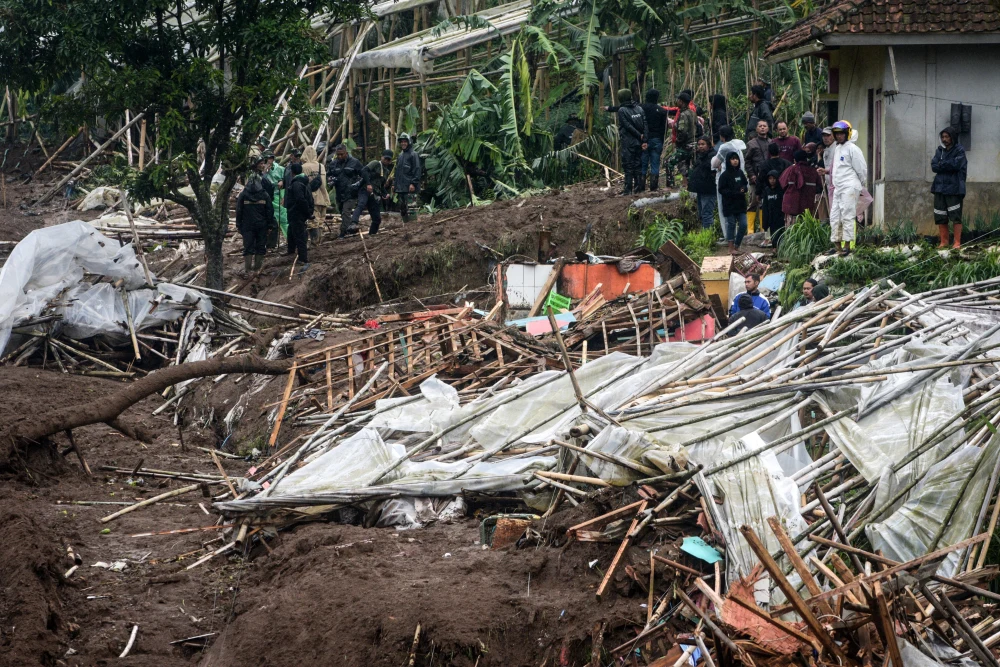
On Saturday, just before dawn at 3 a.m., heavy rainfall caused rivers to burst their banks, unleashing a torrent of mud, rocks, and uprooted trees upon Pasir Langu village in West Java province. The sheer force of the debris tore through the landscape, transforming green-terraced rice fields into murky brown wastelands.
According to officials, the disaster buried approximately 34 houses under heaps of earth. While 24 people managed to escape the carnage, the toll is heavy. At least eight bodies were pulled from the worst-hit hamlet of Pasir Kuning, marking this as a particularly deadly landslide on Indonesia during the current rainy season.
A landslide on Indonesia’s Java island: image from google
The Desperate Search for Survivors
Currently, the primary focus is the search for 82 residents who are feared buried beneath the debris. Television footage has shown a mix of professional rescuers and local residents digging desperately through the thick mud.
However, the operation is fraught with danger. Teten Ali Mungku Engkun, the head of West Java’s Disaster Management Office, noted that unstable soil and continuing heavy rain are complicating the efforts. Following this landslide on Indonesia, local authorities have had to move quickly, deploying emergency response teams and evacuating families living within 100 meters of the zone due to fears of further slope failures.
Why Do Landslides Happen Frequently in Indonesia?
To understand the context of this tragedy, we must look at the geography and climate of the region. Indonesia is an archipelago comprising over 17,000 islands, where millions of people live in mountainous areas or near fertile floodplains.
Seasonal rains and high tides, which typically occur from October to April, frequently cause flooding and soil instability. These seasonal patterns are a major contributing factor to almost everylandslide on Indonesia. Just last January, more than 20 people were killed in Central Java under similar circumstances, highlighting the persistent risks faced by these communities.
A Recent History of Extreme Weather
This event follows a catastrophic period for the country. In December, severe flooding and landslides struck Sumatra, Indonesia’s largest island. That disaster resulted in at least 1,200 deaths and over 7,000 injuries. These historical data points serve as a grim reminder of the volatility surrounding a landslide on Indonesia and the urgent need for disaster preparedness.
Safety Warnings and Precautions
In the wake of the West Bandung disaster, authorities are urging high vigilance. Residents living in landslide-prone areas have been advised to evacuate immediately if they notice specific warning signs.
Signs of an impending landslide include:
Hearing deep rumbling sounds.
Seeing visible soil movement or cracks in the ground.
Sudden changes in water flow or river levels.
Authorities are hoping that early detection can prevent further loss of life from a landslide on Indonesia in the future.
Conclusion:
As the search for the 82 missing residents continues, the nation mourns the lives lost in Pasir Langu. The bravery of the rescuers digging through deep mud offers a glimmer of hope amidst the devastation. As we wait for more news, the focus remains on recovery and support for the victims of this tragic landslide on Indonesia.
Frequently Asked Questions (FAQs)
1. Where exactly did the recent landslide occur? The landslide occurred in Pasir Langu village, located in the West Bandung district of West Java province, Indonesia.
2. What caused the landslide in West Bandung? The disaster was triggered by days of torrential rains which caused rivers to burst their banks, leading to unstable soil and the eventual collapse of the mountainside.
3. Is it common to have a landslide on Indonesia? Yes, unfortunately. Seasonal rains from October to April frequently cause flooding and landslides because many people live in mountainous areas or near floodplains across the archipelago.
The US economy just pulled off a major surprise, growing way faster than anyone anticipated in the third quarter of 2025.
According to the latest final numbers from the Bureau of Economic Analysis (BEA), the economy expanded at an annualized rate of 4.4% during July, August, and September. To put that in perspective, economists were only expecting about 3.3% growth. Not only did we beat the forecast, but this is also the fastest growth sprint we’ve seen in two years.
This is a solid jump from the 3.8% growth we saw in the second quarter and a massive turnaround from the sluggish start to the year when the economy actually shrank by 0.6%. If you average it all out, we’re looking at a steady 2.5% growth rate for the first nine months of 2025.
So, what’s driving this surge? In short: we are. Consumer spending is up, but it’s not just that. Exports, government spending, and business investments are all climbing, while imports have dropped off.
The BEA noted that compared to earlier in the year, private investment and government spending really picked up the slack, and shoppers continued to open their wallets. A key metric that tracks private demand (consumer spending plus investment) rose by 2.9%, signaling that the core of the economy is on solid footing.
Option 2: Professional but Accessible (Modern Journalism)
Defying expert predictions, the U.S. economy shifted into high gear during the third quarter, marking its fastest pace of expansion in two years.
The Commerce Department’s final reading shows GDP hit an annualized rate of 4.4% for the period covering July through September. That figure handily beat the 3.3% growth that economists had forecasted.
This performance builds on momentum from the second quarter, where the economy grew by 3.8%, effectively erasing the contraction we saw at the start of 2025. Taken as a whole, the U.S. economy has maintained a healthy 2.5% annualized growth rate through the first three quarters of the year.
Key Drivers of Growth: The Bureau of Economic Analysis attributes this acceleration to a broad-based recovery. Americans are spending more, exports are rising, and both government and private investments are ticking upward.
Essentially, all cylinders are firing. “Real final sales to private domestic purchasers”—a fancy term for private spending and investment—rose nearly 3% this quarter. The data suggests that despite earlier headwinds, domestic demand remains resilient and strong.
US economy expands by more than initially reported
GDP Report Breakdown: US Economy Expands on Tech and Consumer Spending
The latest data from the Bureau of Economic Analysis (BEA) brings some decidedly positive news. The US economy expands by slightly more than the experts initially calculated, signaling resilience in the face of global challenges.
Released on January 22, the updated report paints a picture of a robust system that is picking up speed rather than slowing down. Let’s dive into what the numbers say, what is driving this growth, and what it means for your wallet and interest rates.
US economy expands by more than initially reported:imgae from google
The Revised Q3 Numbers
The headline number is impressive. Inflation-adjusted gross domestic product (GDP)—the scorecard for everything the country produces—increased at a revised 4.4% annualized rate. This is the fastest pace recorded in two years.
Initially, reports suggested good growth, but this revision confirms that the US economy expands with even more momentum than previously thought. This marks one of the strongest back-to-back quarters for growth since 2021, back when the nation was rebounding rapidly from the pandemic lockdowns.
Table of Contents
What Is Driving the Growth?
It isn’t just one sector doing the heavy lifting. The growth is broad-based, fueled by American households and forward-looking businesses.
The Power of the Consumer
Consumer spending remains the undisputed engine of the American market. In the third quarter, spending advanced at a 3.5% annualized pace. This is a crucial metric because when people feel confident enough to spend, the US economy expands naturally.
This surge wasn’t limited to just buying goods; there was a significant jump in spending on services—the fastest pace in three years. Despite erratic trade policies and fluctuating costs, American households have held up remarkably well, continuing to shop and travel.
Business Investment and AI
It isn’t just shoppers keeping things moving. Businesses are opening their checkbooks, too. Business investment grew at a 3.2% rate, largely driven by spending on computer equipment. Interestingly, the way the US economy expands is shifting toward the future: investment in data centers, which are essential for housing artificial intelligence (AI) infrastructure, climbed to a fresh record.
What This Means for Interest Rates
With such strong growth data, all eyes turn to the Federal Reserve. Usually, when the economy runs this hot, there is a fear of inflation spiking. The report showed that the “core” inflation metric (excluding food and energy) rose by 2.9%.
Because inflation remains above the Federal Reserve’s target, policymakers are in a tricky spot. Even as the US economy expands, the Fed is expected to leave interest rates steady at their upcoming meeting. They are balancing the need to keep prices stable while acknowledging that the job market remains steady and initial unemployment claims are low.
Part of the reason for the revision was stronger exports and a smaller drag from inventories. Earlier in the year, companies rushed to import goods to beat potential sweeping tariffs. Now, that tempo has dialed back, normalizing the flow of trade.
Because these swings in trade can sometimes distort the main GDP number, economists like to look at “final sales to private domestic purchasers.” This measures underlying demand without the noise of inventory shifts. This metric climbed at a 2.9% rate, proving that the foundation upon which the US economy expands is solid and consistent.
Conclusion
The latest data from the BEA offers a reassuring sign. Between record investment in AI infrastructure, a resilient job market, and confident consumers, the financial landscape is outperforming expectations. While interest rates may stay steady for now to keep inflation in check, the latest report is undeniable proof that the US economy expands on a firm footing as we move forward.
Frequently Asked Questions (FAQs)
1. Why was the GDP growth figure revised upwards? The GDP was revised from earlier estimates because new data showed stronger exports and less of a negative impact (drag) from business inventories than initially calculated.
2. How does this growth affect interest rates? Because the economy is growing strongly and inflation is still slightly above the target, the Federal Reserve is expected to keep interest rates steady rather than lowering them immediately. They want to ensure inflation remains under control.
3. What is the main driver of the US economy right now? Consumer spending is the main engine. It grew at a 3.5% pace, driven by a strong demand for services and goods. Additionally, business investments in computer equipment and data centers (for AI) are helping drive growth.